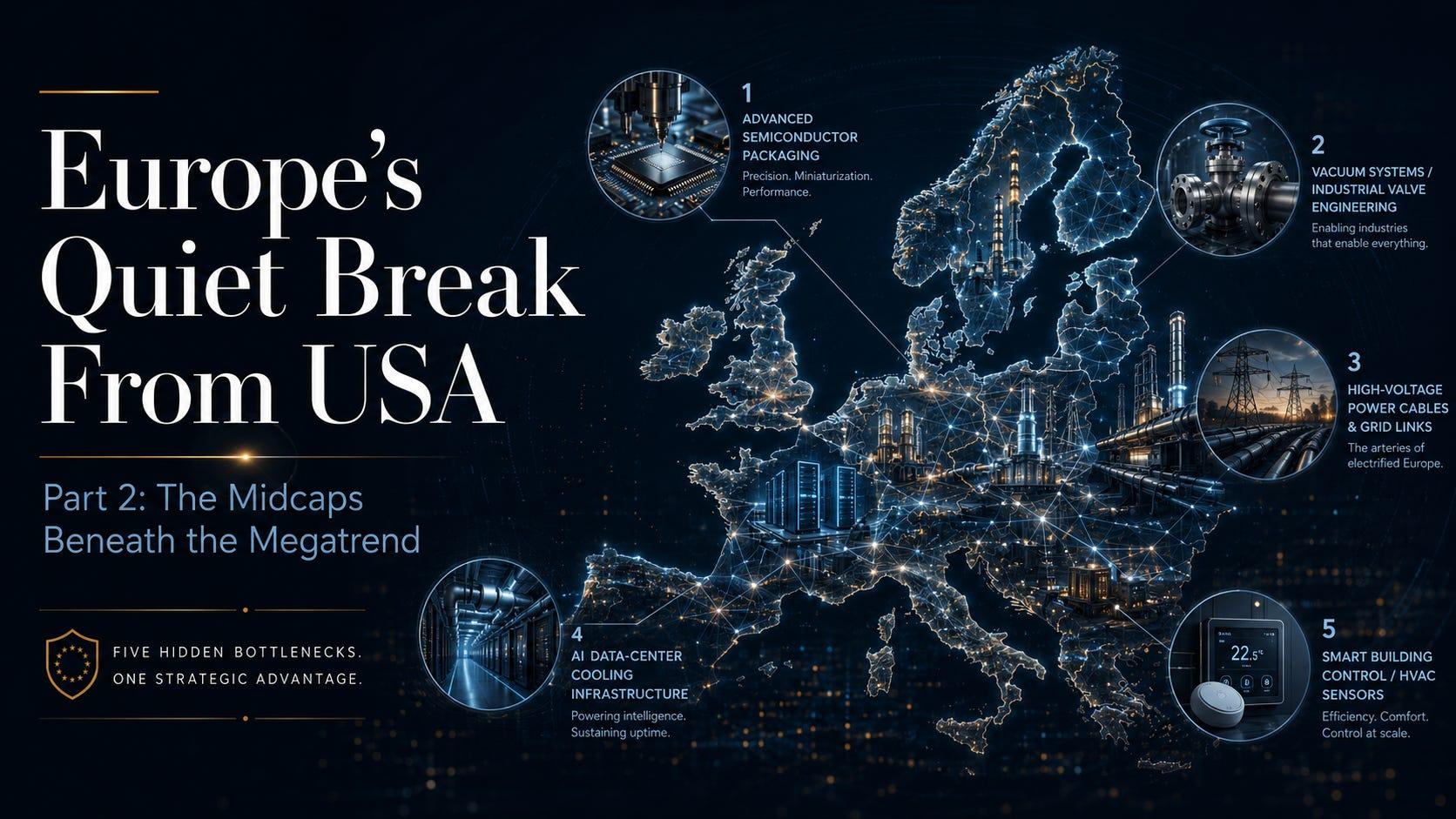
In Part 1, the thesis was simple:
Europe is not divorcing America.
Europe is buying insurance.
Not ideological independence. Not some fantasy of total self-sufficiency. Just redundancy where dependence has become dangerous.
That idea still works.
But the first version of the trade has already been discovered.
Defense stocks ran.
Cyber got crowded.
Sovereign cloud became a buzzword.
Semiconductors became obvious.
The next layer is more interesting.
Because strategic autonomy does not only require fighter jets, cloud servers, and chip fabs.
It requires the parts underneath them.
The machines that package chips.
The valves inside vacuum chambers.
The cables that move electricity.
The cooling systems that keep AI infrastructure alive.
The control devices that make buildings consume less energy.
This is the midcap version of the Europe-autonomy trade.
Not the headline companies.
The bottleneck suppliers.
And that is usually where the better percentage upside lives.
The screen
The goal here is not to find the cheapest stock in Europe.
Cheap can stay cheap.
The goal is also not to buy turnaround stories.
Turnarounds have one problem in this theme: they need to fix themselves before they can capture the opportunity.
That is not the best setup.
If Europe is rebuilding critical capacity, the winners should already be trusted suppliers. Already profitable. Already taking orders. Already sitting in supply chains where failure is expensive.
So the filter is:
No broken companies.
No policy zombies.
No “maybe next year” stories.
Only midcaps that are already working — and become more important if Europe keeps moving from efficiency to resilience.
1. BE Semiconductors — the chip bottleneck after ASML
The lazy semiconductor thesis is: buy ASML.
That is not wrong.
It is just obvious.
The more interesting question is what happens after the wafer is made.
AI chips are becoming less about one monolithic die and more about connecting multiple pieces of silicon into one powerful system. Logic, memory, photonics, advanced substrates, high-bandwidth memory — the game is increasingly about packaging.
That is where BESI matters.
BESI makes advanced assembly and packaging equipment. The company is especially relevant in hybrid bonding, one of the key technologies for stacking and connecting chips more efficiently.
This is not the old back-end semiconductor industry where packaging was treated like a low-value afterthought.
Packaging is becoming part of performance.
And when packaging becomes part of performance, the equipment supplier becomes strategic.
The numbers show the inflection. In Q1 2026, BESI orders rose to €269.7 million, up 104.5% year over year. Revenue increased 28.3% to €184.9 million, and net income rose 63.8% to €51.6 million. Management guided Q2 revenue to grow another 30–40% versus Q1, with gross margin expected at 64–66%. (Besi)
That is not a turnaround.
That is demand pulling through a high-margin niche leader.
The strategic angle is simple: Europe does not need to own the whole semiconductor stack to have leverage. It needs to own difficult pieces of the stack that others cannot easily replace.
BESI is one of those pieces.
The risk: semiconductor equipment is cyclical. AI packaging demand can be real and still arrive in waves. The stock will not move like a utility.
The reason it belongs: if advanced packaging becomes one of the next bottlenecks in AI hardware, BESI is one of Europe’s cleanest midcap ways to own that bottleneck.
2. VAT Group — the invisible valve tollbooth
VAT sounds boring.
That is almost the entire attraction.
Semiconductor fabs need vacuum systems. Vacuum systems need high-performance valves. Those valves have to work with extreme precision, reliability, and cleanliness.
Nobody builds a political speech around vacuum valves.
But no advanced fab runs without them.
VAT Group is a Swiss leader in high-end vacuum valves, heavily exposed to semiconductor manufacturing. This makes it a picks-and-shovels company inside the chip sovereignty trade.
Not the fab.
Not the chip designer.
Not the lithography king.
The supplier inside the process that people only notice when it becomes scarce.
Q1 2026 confirmed the demand signal. VAT’s valve order intake reached CHF 303.9 million, up 50.8% year over year. Semiconductor valve orders rose 64.5% year over year. Group orders were 47% higher than the same quarter in 2025, and VAT reiterated that full-year 2026 orders, sales, EBITDA, EBITDA margin, net income, and free cash flow should all be higher than in 2025. (VAT)
There was a temporary revenue issue in Q1 from supply-chain disruptions and customer-specification changes, but the important part is that VAT reaffirmed the full-year outlook. (VAT)
That matters.
A weak company misses and cuts.
A quality bottleneck supplier can have a messy quarter and still keep the year intact.
The risk: VAT is still tied to semiconductor capex cycles. If fab spending slows, the stock will feel it.
The reason it belongs: strategic autonomy in chips is not just about giant fabs. It is about the precision supply chain inside those fabs. VAT is one of those invisible tollbooths.
3. NKT — the cable company Europe cannot ignore
Energy independence sounds grand.
In practice, it needs cables.
Offshore wind needs cables.
Interconnectors need cables.
Grid upgrades need cables.
Data centers need cables.
Industrial electrification needs cables.
This is where NKT becomes interesting.
Prysmian is the obvious large-cap cable stock. NKT is the midcap version with more focused exposure to high-voltage cable demand.
And Europe’s grid problem is not optional.
If the continent wants more renewables, more domestic power, more electrified industry, and more AI infrastructure, it has to move electricity from where it is produced to where it is consumed.
That sounds basic.
It is also one of the largest bottlenecks in the entire autonomy project.
NKT’s Q1 2026 looked better underneath than on the surface. Revenue was €864 million, slightly up from €837 million a year earlier. Operational EBITDA rose to €97 million from €81 million, and operational EBITDA margin improved to 16.0% from 12.9%. More importantly, Q1 brought the highest quarterly order intake in NKT’s history, helped by two major high-voltage projects worth more than €4.2 billion combined. (NKT Anleger)
The backlog is the real story. NKT’s Transmission order backlog reached €13.5 billion at the end of Q1 2026. The company also maintained 2026 guidance for revenue at standard metal prices of €2.63–2.78 billion and operational EBITDA of €360–410 million. (Quartr)
This is why NKT fits the theme.
Europe can announce energy sovereignty all it wants.
Without transmission capacity, it is just a slogan.
The risk: large cable projects are complex. Execution, installation timing, metals pricing, and project delays matter.
The reason it belongs: NKT sits inside the physical bottleneck of European electrification. If the grid cycle lasts for years, this is not a small theme.
4. Munters — AI infrastructure is a heat problem
The market understands GPUs.
The market understands data centers.
The market is slowly understanding that AI is also a cooling problem.
AI factories consume enormous power and generate enormous heat. If the heat is not managed, the compute does not work.
That makes cooling infrastructure strategic.
Munters provides climate-control and air-treatment solutions. Its Data Center Technologies business puts the company directly in the path of AI-driven infrastructure demand.
This is where the Europe-autonomy thesis gets more physical.
Digital sovereignty is not just where data is stored.
It is where compute is built.
And compute needs power, cooling, reliability, and uptime.
Munters’ Q1 2026 order intake increased 32%, with strong demand in Data Center Technologies and growth across its business areas. Its order backlog was up 88%, or 96% currency-adjusted, according to the company’s Q1 presentation. (Munters)
This is the most operationally mixed name in the basket. Net sales declined because of currency effects, and adjusted EBITA margin fell from a high level due to tariff headwinds, product transitions in Data Center Technologies, and planned investments in FoodTech. (Munters)
That makes Munters different from Belimo or VAT.
It is not the cleanest compounder.
But it is also not a turnaround.
The demand is there. The backlog is there. The question is how well the company converts that demand into margin as the data-center business scales.
The risk: margin execution. This is the highest-execution-risk name on the list.
The reason it belongs: if AI infrastructure keeps expanding in Europe and globally, cooling becomes a bottleneck. Munters is one of the more direct European midcap ways to play that physical layer.
5. Belimo — the quiet compounder inside buildings
Belimo is the highest-quality business on this list.
It is also probably the least exciting to describe.
The company makes actuators, control valves, sensors, and meters for heating, ventilation, and air-conditioning systems.
That sounds like industrial plumbing.
But buildings are one of Europe’s biggest energy problems.
If Europe wants energy resilience, lower consumption, smarter buildings, healthier indoor environments, and less stress on the grid, it needs better building control.
Belimo sells the devices that make that possible.
And unlike many “energy efficiency” stories, this one already has the numbers.
In 2025, Belimo grew net sales 23.3% in local currencies to CHF 1.12 billion. EBIT increased 28.6% to CHF 232.9 million, and EBIT margin expanded to 20.8%. ROCE reached 36.3%. (Belimo - Annual Report 2025)
That is not a subsidy story.
That is a quality-compounding story.
The data-center angle is also becoming more relevant. Belimo says its position in HVAC field devices has helped it provide data-center cooling solutions, where reliability and quality are critical. (Belimo)
This is the kind of company that can be easy to ignore because it never sounds dramatic.
But the more Europe electrifies, digitizes, and tries to reduce energy waste, the more building controls matter.
Energy autonomy is not only about producing more energy.
It is also about wasting less of it.
The risk: valuation. Quality midcaps rarely look optically cheap when the market understands them.
The reason it belongs: Belimo is a proven compounder sitting at the intersection of HVAC efficiency, building automation, and data-center cooling.
The ranking
Not all five names are the same type of bet.
Best quality compounder: Belimo
Best semiconductor packaging upside: BESI
Best invisible chip-infrastructure tollbooth: VAT Group
Best Europe grid bottleneck: NKT
Best AI cooling torque: Munters
That distinction matters.
A basket like this should not be treated as five identical stocks.
Belimo is quality first.
BESI is cycle plus technology inflection.
VAT is niche dominance.
NKT is backlog and grid capacity.
Munters is demand plus margin execution.
The common thread is not sector.
The common thread is bottleneck power.
Each company sells into a part of the system that becomes more valuable when Europe stops assuming global supply chains will always be cheap, open, and politically frictionless.
The real point
The first phase of Europe’s quiet break was easy to see.
Defense.
Cyber.
Cloud.
Satellites.
The second phase will not look as dramatic.
It will look like a packaging tool order.
A vacuum valve shipment.
A cable backlog.
A cooling system contract.
A building-control upgrade.
That is how real industrial shifts usually happen.
Not with one giant headline.
But through thousands of purchasing decisions that look boring until they become obvious.
Europe is not trying to become an island.
It is trying to become less fragile.
And fragility is usually hidden in the parts nobody talks about.
That is why the midcaps matter.
BESI.
VAT Group.
NKT.
Munters.
Belimo.
Not the loudest names in the market.
But potentially the suppliers sitting closest to the physical bottlenecks of European resilience.
And once a bottleneck becomes strategic, the company controlling it stops being boring.
This article is for research and education only. It is not financial advice or a recommendation to buy or sell any security. Midcap stocks can be volatile and less liquid than large caps. Always check valuation, balance sheet strength, cyclicality, customer concentration, order quality, and execution risk before investing.