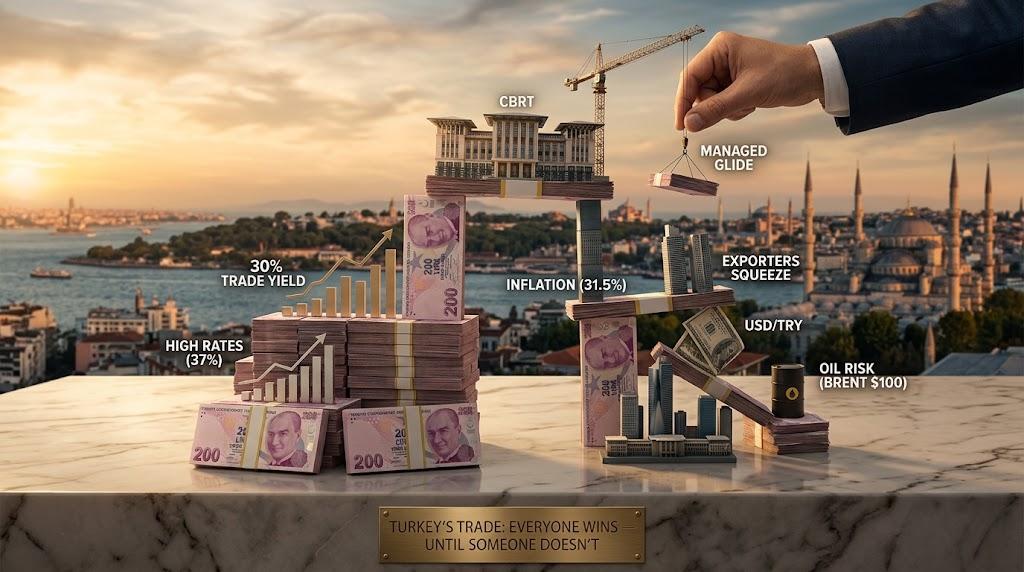
Last year, one of the best trades in global markets required no stock-picking, no leverage and no genius. You bought Turkish lira, parked them in a money-market fund, and waited.
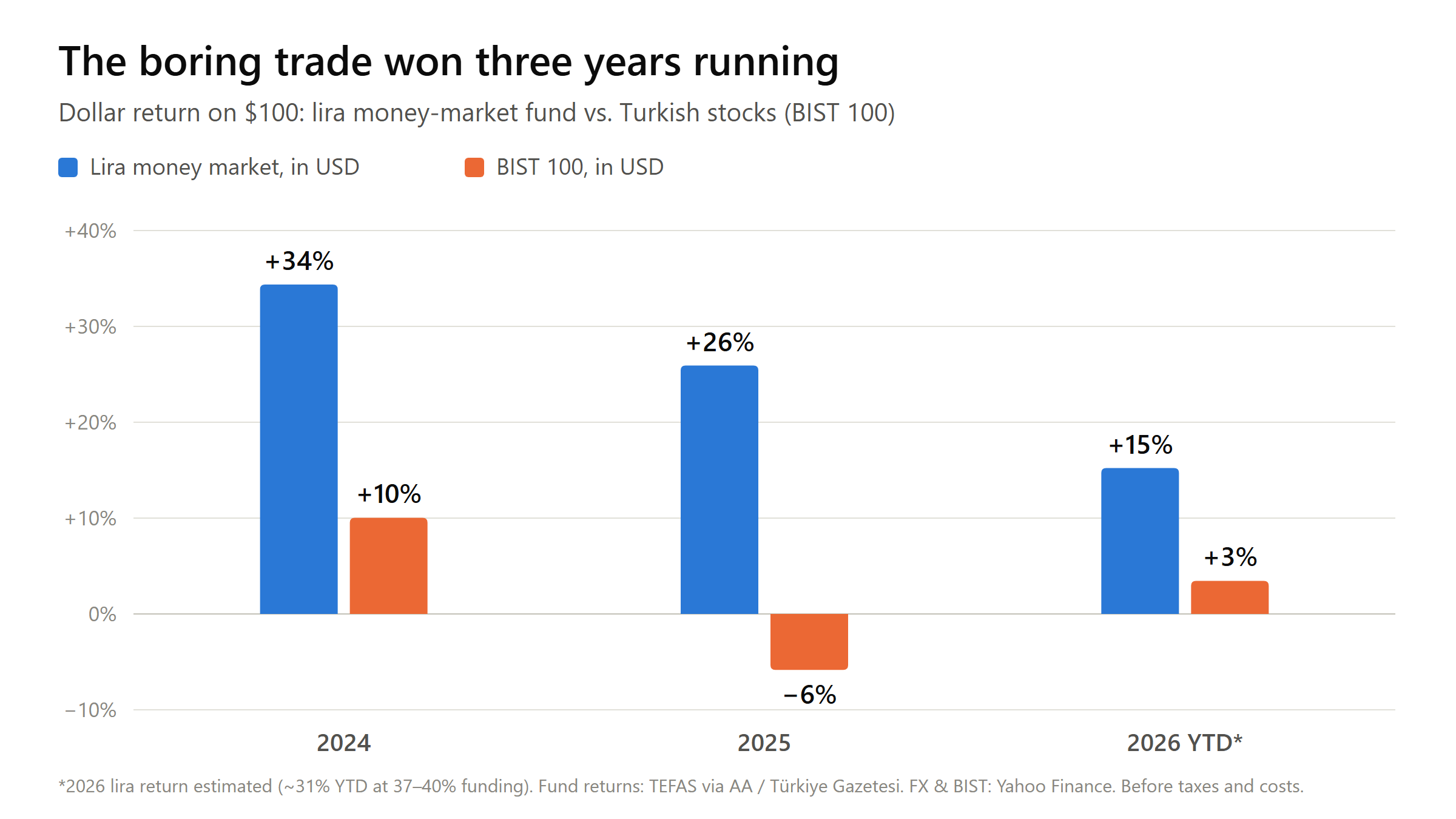
The average lira money-market fund returned 53% in 2025. Over the same period the lira lost about 18% of its value against the dollar. Net result: roughly +26% in dollar terms and close to 30% annualised for anyone who bought into the March 2025 panic. The year before, when money-market funds returned 61% in lira, the same trade made about 34% in dollars.
Meanwhile Turkish stocks, the “obvious” way to play a recovering economy, lost about 6% in dollar terms in 2025.
So here is the question every investor in this trade should be asking: if the trade is this good, who is paying for it — and what happens when they stop?
The answer is a game. Literally. Let’s play it.
The rules: you earn the rate, you lose the slide
The mechanics fit in one sentence: you earn the interest rate, you lose the depreciation, you keep the difference.
Turkey’s central bank (CBRT) runs a policy rate of 37% while inflation sits at 31.5%. Crucially, it lets the lira weaken only slowly about 1.5% a month this year even though prices are rising faster than that. That managed glide is the whole business model. As long as the lira falls more slowly than the interest you collect, you win.
It is not a secret. Foreign investors have piled an estimated $75 billion into high-yielding lira swaps and money-market funds, according to Bloomberg. That is a lot of money that can leave in a hurry.
The players
Every game needs players with conflicting incentives. This one has five.
Foreign carry traders want the yield and a lira that doesn’t break. Their weapon is speed: they can leave in days.
The central bank wants disinflation and reserves. Inflows deliver both — until they reverse.
The government wants growth and, eventually, an election win. Early elections are being floated for autumn 2027.
Turkish households want wages that keep up with prices. For now, they don’t get them.
Exporters want a weaker lira. In real terms they are getting a stronger one.
Game one: the stag hunt
Start with the carry traders. Each investor faces the same choice every morning: stay in, or get out.
What makes the choice interesting is that your payoff depends less on Turkey’s fundamentals than on what everyone else does.
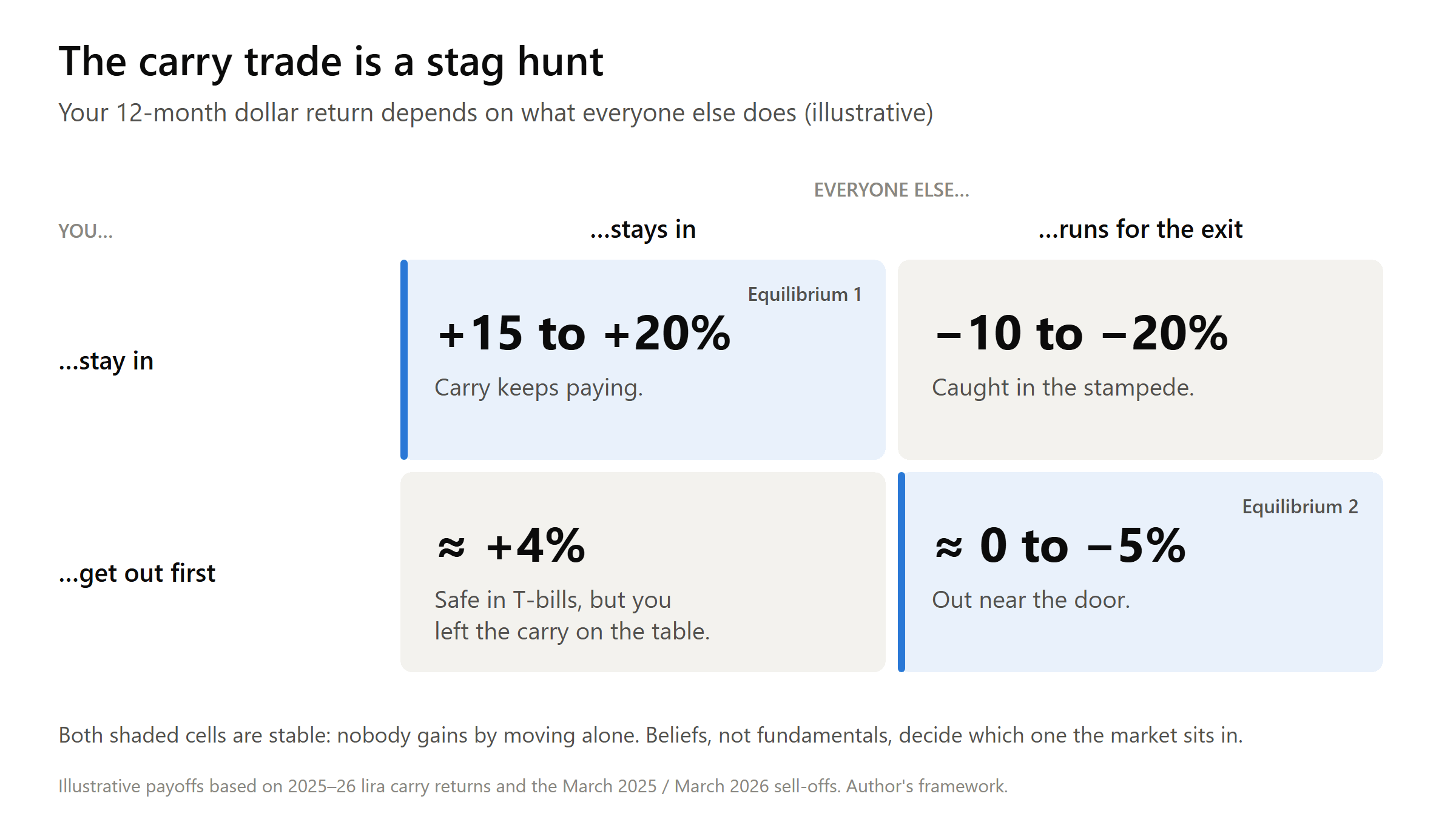
If everyone stays, the carry keeps paying. If you leave early, you are safe in T-bills but miss out. If you stay while everyone else runs, the lira gaps lower within days and a year of carry can vanish in a week.
Game theorists call this a stag hunt. It has two stable outcomes: everyone stays and everyone wins, or everyone runs and the early leavers lose least. Neither is “correct”. The market lands in whichever one investors believe it will land in.
With payoffs like these, staying is rational only as long as you think roughly half the market will stay too. That is the key insight: the carry trade doesn’t end when the fundamentals turn. It ends when the belief flips.
We have watched it flip twice in eighteen months:
March 2025. The arrest of Istanbul mayor Ekrem İmamoğlu triggered the sharpest lira slide in four years and forced hedge funds to unwind.
March 2026. After the Iran war broke out on 28 February, almost $15 billion of carry money left within three weeks. Official reserves fell by a record $43 billion in a single month as the central bank sold dollars to hold the line.
Both times the firewall held, and both times the money came back within months. That is what keeps the “stay” equilibrium alive: investors have learned that the CBRT will defend the lira. The real question is how much firewall is left.
Game two: the countdown
More Articles

AI Is Creating an Inflation Nobody Is Measuring
The cost of producing music, code, and digital labor is collapsing. The volume is exploding. The market consequences are stranger than they look.

AI Won’t Kill SaaS. It Will Charge You Twice.
The old software model charged for employees. The new model charges for employees—and the AI agents doing part of their work.

The AI Trade Is Not a Bubble. It Is a Game of Chicken.
The question is not whether AI is real. The question is who gets paid — and who is only financing the table.