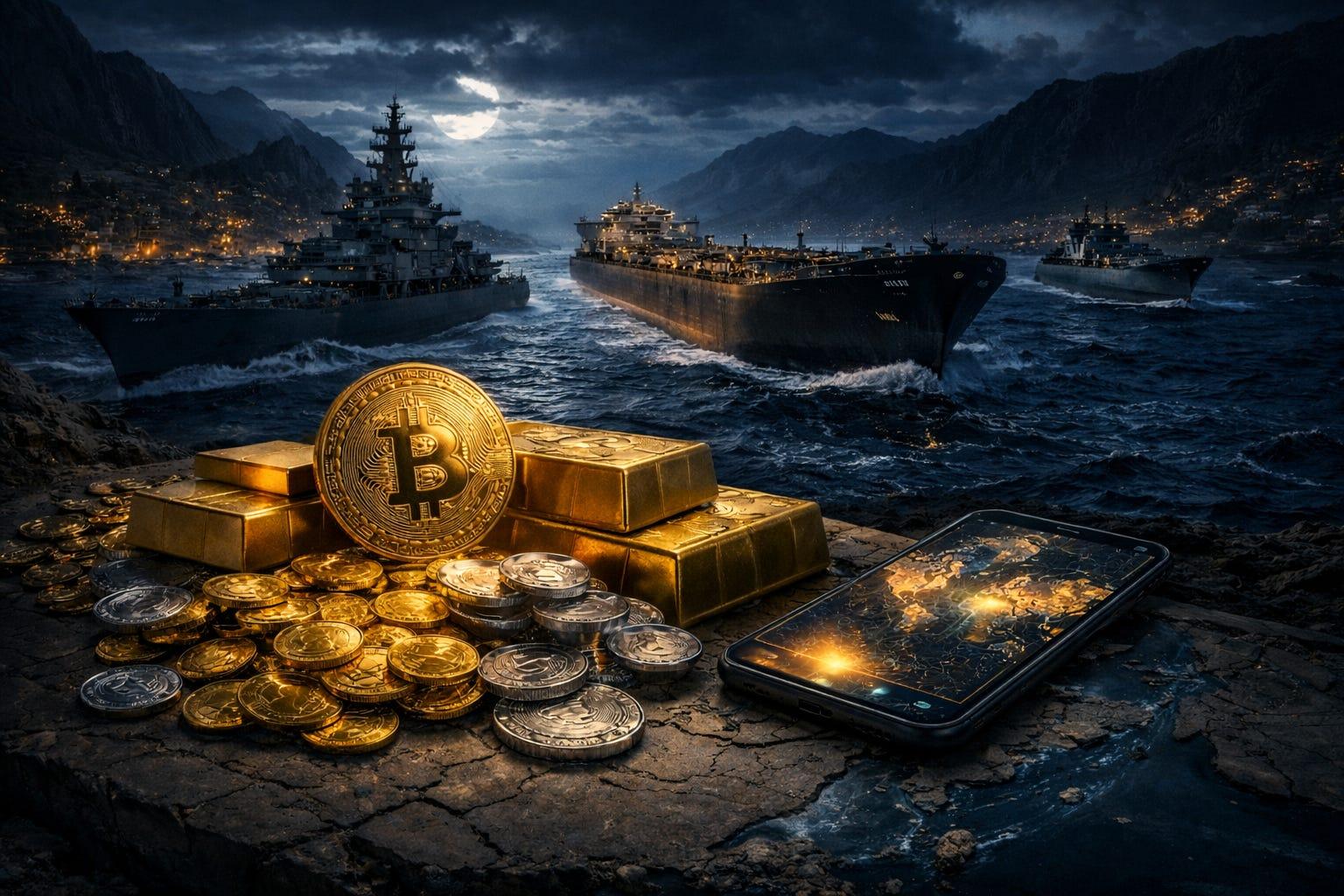
Most chokepoints look physical until the bill arrives.
A tanker moves through a narrow waterway. The cargo is oil. The visible power is military. But the real power may sit somewhere else entirely: in the right to say you can pass, but only on my terms, and only in the money I accept.
That is why the Strait of Hormuz story matters.
Not because it is one more geopolitical scare headline.
But because it hints at the next phase of a multipolar world.
The bottleneck no longer ends with the cargo. It reaches into settlement. Into collateral. Into reserve assets. Into the legal wrapper around money itself.
That changes the investment question.
If strategic chokepoints can start choosing not just who passes, but how payment is made, then this is no longer only an energy story.
It becomes a story about which assets still function when geography, coercion, and money start collapsing into the same game.
That is where gold, silver, Bitcoin, stablecoins, and tokenized metals enter the picture.
Not as buzzwords.
As competing answers to one hard question:
What do states, traders, and reserve managers trust when the route is open only at a price, and the payment rail itself becomes part of the conflict?
That is the real settlement-layer trade.
First principle: this is a game of commitment, not ideology
I do not think this should be analyzed as a morality play about Iran, or as a marketing pitch for crypto, or as a simple anti-dollar story.
It is a strategic game with several players, each facing different incentives.
The key players are:
the chokepoint state,
the Gulf exporters behind the chokepoint,
the importing states that need the cargo,
the naval and sanctions powers that want open passage,
the shipping and insurance layer that has to price real risk,
the settlement networks and reserve managers that decide what counts as acceptable money.
Once you look at it that way, the problem becomes clearer.
The central issue is not whether one specific crypto payment rumor is true down to the last detail.
The central issue is that a chokepoint owner has an incentive to turn military control into recurring rent, and then to choose a settlement rail that maximizes autonomy while minimizing seizure risk.
That is the game.
Player 1: the chokepoint state
Start with Iran.
What does Iran want?
Not just money.
It wants four things at once:
revenue,
political recognition,
deterrence,
and optionality against sanctions.
A toll does all four better than a full blockade.
A full blockade is too escalatory. It invites coalition formation against you. It turns too many neutral players into active opponents.
A selective toll is smarter.
It lets you discriminate.
Friendly cargo can pass.
Neutral cargo can be monetized.
Hostile cargo can be delayed or denied.
That is a much better strategy in game-theory terms because it avoids forcing every other player into a single anti-Iran coalition.
It fragments the response.
That matters.
If Iran can make China think in terms of continuity of imports, Europe think in terms of inflation risk, Gulf exporters think in terms of restored throughput, and shipowners think in terms of getting the vessel through one trip at a time, then the opposition is no longer one bloc.
It becomes a coordination problem.
That is good for Iran.
But there is a catch.
Iran cannot fully commit to restraint.
That is the core weakness of the strategy.
If users believe today’s toll can become tomorrow’s confiscation, then even compliant users start investing in bypass, stockpiles, naval protection, supplier diversification, and alternative settlement systems.
So the short-run equilibrium favors monetization.
The long-run equilibrium punishes overreach.
This is a classic hold-up problem.
The more successful the chokepoint toll is today, the more aggressively the rest of the system finances ways around it tomorrow.
Player 2: the Gulf exporters
The Gulf exporters behind Hormuz are not natural allies of a toll regime, even if some may tolerate it temporarily.
Their dominant objective is throughput.
They want cargo moving, price premia under control, and customers confident enough to keep signing contracts.
A modest crisis premium can help revenue.
A durable traffic tax controlled by a third party is different.
That undermines their own bargaining position.
Why?
Because it inserts a political tax between producer and buyer.
That makes the exporter less reliable even when the exporter itself did nothing wrong.
So their medium-term strategy is rationally to support any mix of diplomacy, escorting, bypass pipelines, and customer reassurance that reduces dependence on discretionary control inside the strait.
They may accept temporary arrangements because the alternative is a total shutdown.
But they do not want the tollbooth to become permanent.
In repeated-game terms, their best response is temporary compliance plus long-run escape investment.
Player 3: the importing states
The major importers do not all face the same payoff matrix.
China, India, Japan, and South Korea all need energy security, but they value different things.
Some care most about uninterrupted physical flows.
Some care most about sanction exposure.
Some care most about alliance cohesion.
Some care most about price.
That means the importer side is not automatically unified.
And that is why a selective passage regime is dangerous.
It is a screening mechanism.
It forces importers to reveal what they value most.
Will they pay in a politically inconvenient currency?
Will they accept a non-dollar rail?
Will they tolerate a premium for continuity?
Will they publicly object while privately adapting?
That information is valuable to the chokepoint owner.
But the importers also learn something.
They learn that physical access and payment access are no longer separable.
That pushes them toward three rational responses:
first, diversify routes where possible,
second, increase inventories and strategic reserves,
third, diversify settlement options so they are not trapped by a single political rail.
This is the real multipolar shift.
Not that everyone abandons the dollar tomorrow.
But that more states want backup settlement architecture because they now see payment networks as part of the coercion layer.
Player 4: the naval and sanctions powers
For the United States and allied maritime powers, open passage is not just about oil.
It is about the rule that strategic waterways are not supposed to become private toll roads under military duress.
If that norm breaks, the cost is not limited to Hormuz.
It changes expectations everywhere.
So the U.S. objective is larger than restoring one corridor.
It is to preserve the principle that transit cannot be permanently repriced by force.
But the U.S. also has a commitment problem.
Using maximum force to reopen a strait can itself widen the conflict and raise energy prices.
So Washington is pulled between two strategies:
credible deterrence,
and escalation avoidance.
That tension is exactly why gray-zone monetization is attractive for the chokepoint state.
It sits below the threshold that makes an overwhelming military response easy to coordinate.
So the likely Western strategy in this kind of repeated game is not constant direct confrontation.
It is a layered response:
insurance support,
naval presence,
diplomatic pressure,
secondary sanctions,
route diversification,
and long-run investment in alternative infrastructure.
That matters for investors because it means the market response is usually not a single dramatic event.
It is a slow repricing of whole systems.
Pipelines.
Ports.
Storage.
Naval procurement.
Reserve assets.
Settlement rails.
Player 5: shipping and insurance
This layer is underrated.
Shipowners and insurers do not care about ideology.
They care about expected loss.
That makes them some of the most important transmission mechanisms in the whole game.
A shipping corridor does not need to be fully closed to become economically impaired.
It only needs uncertainty high enough that insurance spikes, crews object, shipowners delay, and lenders start asking harder questions.
That creates an asymmetric payoff.
The chokepoint owner does not need to stop every ship.
It only needs to make the marginal voyage hard enough to price.
That means an alternative settlement system can matter even before it becomes globally significant.
If it reduces delay, gets a ship cleared faster, or lowers some layer of sanction or documentation friction, it can gain tactical relevance well before it gains strategic dominance.
That is why transactional rails and reserve assets should not be confused.
A rail can win flow without becoming money.
Player 6: the settlement networks and reserve managers
Now we get to the asset question.
This is where most people become intellectually lazy.
They hear “sanctions resistance” and immediately jump to Bitcoin.
Or they hear “tokenization” and immediately jump to Ethereum.
Or they hear “stable payment” and immediately jump to stablecoins.
That is too shallow.
Different assets solve different game-theory problems.
The right question is not “which asset is best?”
The right question is: best for whom, and for what move in the game?
The key distinction: transaction rail versus reserve asset
This is the single most important distinction in the whole piece.
A transaction rail is the thing you use to move value through the system.
A reserve asset is the thing you trust to sit outside the system when politics turns hostile.
Those are not the same thing.
And in many cases the best transaction rail is a terrible reserve asset.
That is why so much crypto analysis goes wrong.
It keeps mixing up transport with sovereignty.
Gold: the strongest sovereign-neutral reserve asset
Gold remains the cleanest strategic reserve asset in a multipolar world.
Why?
Because it solves the commitment problem better than almost anything else.
It is not somebody else’s liability.
It does not depend on a payment network staying politically open.
It does not require electricity to settle inside a crisis.
It is globally legible collateral.
And unlike most digital assets, it has already been accepted by states for centuries.
Gold’s weakness is obvious.
It is heavy, slow, and operationally inconvenient.
That is exactly why it is strong as a reserve asset and weak as a high-frequency transaction rail.
In game-theory terms, gold is not good at optimizing daily flow.
It is good at minimizing dependence.
That is why central banks buy it when geopolitical trust falls.
Gold is what states migrate toward when they want optionality without asking permission.
So if the world becomes more multipolar, I do not think gold becomes less relevant.
I think it becomes more relevant.
Silver: more convex, less sovereign
Silver belongs in the discussion, but not in exactly the same role.
Silver has monetary history, but in the current system it behaves more like a hybrid asset.
Part monetary metal.
Part industrial input.
That gives it a very different payoff profile.
Silver can outperform gold in periods when monetary fear and industrial bottlenecks reinforce each other.
That makes it more convex.
But it also makes it less clean as a reserve asset.
Why?
Because a sovereign reserve manager values portability, compactness, and official acceptance.
Gold wins that contest easily.
Silver is bulkier, more volatile, and more exposed to industrial substitution and inventory cycles.
So in a multipolar world I would not treat silver as the primary sovereign money hedge.
I would treat it as the higher-beta precious-metals expression of the same strategic stress.
Gold is the reserve.
Silver is the torque.
That is a useful distinction.
Bitcoin: the strongest digital bearer asset, but not the best working-capital rail
Bitcoin is the hardest digital asset to dismiss because it solves a very specific problem better than anything else.
It has no issuer.
No foundation with redemption discretion.
No company that can freeze the asset.
No presale structure that permanently embeds a legal issuer above the network.
That matters.
It is the closest thing crypto has to politically neutral digital collateral.
And yes, there is one huge reason Bitcoin remains unique.
Its founder left.
That was not a sideshow.
That was part of the asset.
Satoshi’s disappearance removed the central founder bargaining problem from the system.
There is no CEO treasury to monitor.
No foundation board with formal reserve control.
No issuer standing above the protocol and promising not to abuse power later.
That is why Bitcoin still stands alone in legitimacy terms.
Its launch was public.
Its software was released openly.
There was no ICO.
There was no explicit foundation allocation written into the asset at birth.
That does not make Bitcoin perfect.
It has three obvious weaknesses for this specific Hormuz-type use case.
First, volatility.
A toll collector does not want the invoice value moving wildly between departure and confirmation.
Second, throughput and visibility.
Bitcoin is excellent for bearer-style final settlement, but less natural for routine, high-volume trade invoicing.
Third, energy politics.
Proof-of-work is part of Bitcoin’s security model, but it is also a political liability in a world where electricity itself is becoming strategic.
That does not kill Bitcoin.
It narrows Bitcoin.
Bitcoin is strongest as reserve escape, sovereign hedge, or collateral outside the formal system.
It is weaker as the default day-to-day trade rail.
That is a very important distinction.
Ethereum: better infrastructure, weaker neutrality
Ethereum is the opposite profile.
It is much more flexible as financial infrastructure.
It is much better suited to tokenization, stablecoins, programmable escrow, and complex settlement logic.
And after the move to proof-of-stake, it is dramatically less energy-intensive than Bitcoin.
So if the question is “which crypto rail is more practical for tokenized trade finance, tokenized commodities, or stablecoin settlement?” the answer is obvious.
Ethereum is more useful.
But useful is not the same as neutral.
Ethereum began with a large genesis allocation, and that matters.
The network also depends on a proof-of-stake structure where validator influence, staking intermediaries, and governance culture matter more than they do in Bitcoin.
That makes Ethereum a stronger infrastructure asset than a sovereignty asset.
In other words:
Bitcoin is better money than software.
Ethereum is better software than money.
That is the cleanest way to frame it.
Stablecoins: best transport, worst sovereignty
Stablecoins are the cleanest answer if the objective is just moving value fast.
They are available around the clock.
They are easy to integrate.
They settle much faster than legacy correspondent systems.
And in many jurisdictions they are already the real transactional bridge between crypto and the dollar system.
But they fail the sovereignty test.
The reason is simple.
Someone can freeze them.
That means they are efficient claims.
Not politically neutral money.
In a calm world, that is good enough.
In a fragmented world, it is a major weakness.
A state that wants sanctions resilience does not actually want an asset with a remote kill switch sitting inside a regulated issuer.
So stablecoins can absolutely win volume.
But they do not fully solve the strategic problem.
They are transport rails, not escape assets.
Gold-backed and silver-backed crypto: bridge instruments, not final refuges
This is where caution matters most.
Tokenized gold and tokenized silver sound ideal on paper.
You get precious-metal backing plus digital mobility.
You get easier transferability than physical bullion.
You get 24/7 markets.
You get divisibility.
But the game-theory problem reappears immediately.
Who verifies the metal?
Who controls redemption?
Who holds the bars?
Who gets paid first in insolvency?
Who can freeze the token?
Which jurisdiction controls the vault?
What happens if the issuer is lying?
That is why tokenized gold or silver should never be treated as equivalent to physical metal in hand.
They are wrappers.
Useful wrappers, maybe.
But wrappers.
And wrappers fail in very predictable ways.
Failure mode 1: redemption asymmetry
In calm conditions, the token tracks the metal.
In stress conditions, what matters is not the headline backing ratio.
What matters is who can actually redeem, at what size, under what legal process, in which jurisdiction, and after how much delay.
That means the market may reprice the wrapper before it reprices the metal.
Failure mode 2: custody-chain break
Even if the issuer is honest, the system still depends on custodians, auditors, legal enforceability, and operational continuity.
So the question is not just “is the gold there?”
It is “can you still get to your claim when the relevant state, bank, or regulator decides this flow is sensitive?”
Failure mode 3: freeze or blacklist risk
Once a token has an issuer, it usually has an intervention layer.
That means the wrapper can become less useful precisely when you most want censorship resistance.
Failure mode 4: confidence run
If enough holders begin to suspect the metal is overstated, encumbered, legally unreachable, or politically vulnerable, then the token can trade like a stressed credit instrument rather than like gold.
That is the key point.
Gold-backed crypto is not “gold on a blockchain.”
It is a claim structure whose credibility depends on governance, law, custody, and redemption.
Sometimes that is good enough.
Sometimes it is not.
The distribution question: is Bitcoin uniquely clean?
Not absolutely clean.
But uniquely clean relative to the field, yes.
Bitcoin still has concentration issues.
Early miners accumulated a lot.
Large custodians and ETFs now hold meaningful balances.
Mining pools matter.
Nothing about any monetary system is perfectly egalitarian.
But Bitcoin’s distribution and control story is still qualitatively different from most of crypto.
Why?
Because its founding structure did not combine all the usual centralization layers.
No ICO.
No explicit premine to a foundation.
No venture allocation written into genesis.
No ongoing issuer with redemption discretion.
No known founder liquidation cycle.
That does not make current ownership perfectly decentralized.
It does make the origin story much cleaner.
Most post-Bitcoin systems are different.
They usually introduce at least one of the following:
premine,
foundation treasury,
team allocation,
VC round,
admin controls,
issuer freeze rights,
or governance concentrated enough that political pressure can travel through identifiable chokepoints.
Not every post-Bitcoin project is identical.
But the general pattern is real.
That is why it is wrong to ask “which crypto is best?” as if they are all solving the same problem.
Bitcoin solves the neutrality problem.
Ethereum solves the programmability problem.
Stablecoins solve the transactional-friction problem.
Gold-backed tokens solve the convenience problem.
Those are not interchangeable.
The real equilibrium in a multipolar world
So what does the equilibrium actually look like if the world keeps fragmenting?
Not one winner.
A stack.
At the top reserve layer, states and reserve managers move toward assets that sit outside other states’ balance sheets.
That favors physical gold first.
Possibly some Bitcoin at the margin.
At the transactional layer, firms use whatever clears fastest and cheapest under current political constraints.
That favors stablecoins, tokenized bank money, regional payment platforms, and eventually bloc-based digital settlement systems.
At the infrastructure-investment layer, investors may prefer the rails that host tokenized activity.
That favors networks like Ethereum more than reserve assets like Bitcoin.
At the high-beta hedge layer, silver can outperform gold when geopolitical stress overlaps with industrial scarcity and investor demand.
But that is a torque trade, not the cleanest sovereignty reserve.
That is the stack.
My hierarchy
For sovereign-neutral reserves: physical gold first.
For higher-beta precious-metal exposure: silver.
For digital bearer collateral outside issuer control: Bitcoin.
For tokenized finance and settlement infrastructure: Ethereum.
For day-to-day transactional throughput: stablecoins.
For convenience exposure to metal on digital rails: tokenized gold and tokenized silver, but only as wrappers with real counterparty and legal risk.