The biggest geopolitical trade of the next few years may not be AI.
It may be insurance.
Not insurance in the literal sense. Political insurance. Supply-chain insurance. Security insurance. Data-sovereignty insurance.
That is the lens I would use to understand what Europe is doing right now.
The lazy version of the story is: Trump returns, Europe panics, Europe decouples from the U.S.
I don’t think that is right.
The more accurate version is both more boring and more investable:
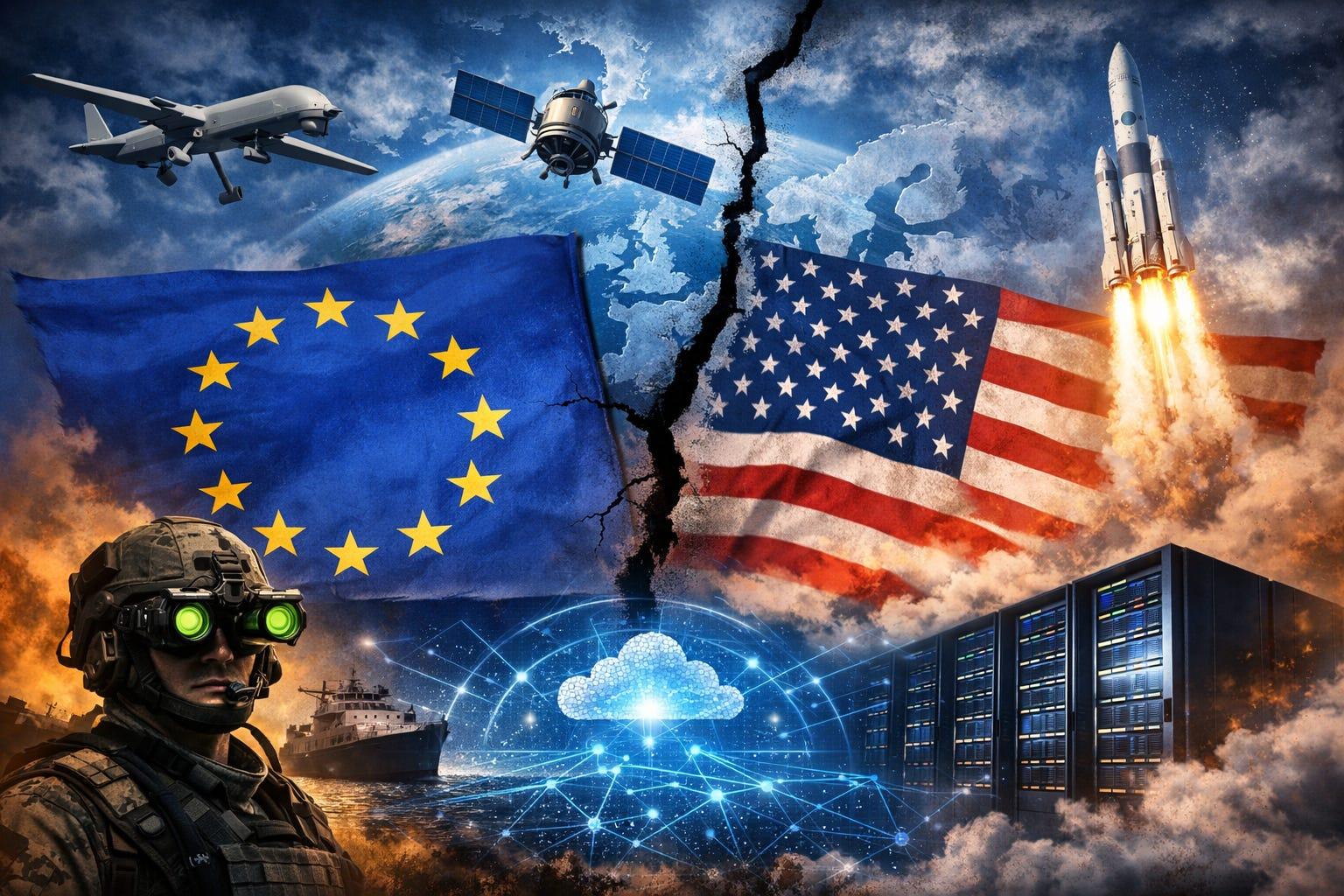
Europe is not trying to divorce America. It is trying to survive an America that has become less predictable.
That difference matters.
Because if this thesis is right, the winners will not be random “anti-U.S.” plays. The winners will be a specific class of domestic companies that sit inside the layers governments do not want to outsource anymore: battlefield systems, secure communications, sovereign cloud, cyber infrastructure, and high-trust industrial capacity.
And once you see it that way, the market starts to look very different.
The real trade is not decoupling. It’s selective strategic autonomy.
Europe is still deeply tied to the United States militarily, financially, and technologically. NATO is not disappearing tomorrow. American hyperscalers are not leaving Europe. U.S. capital is not vanishing.
But a new behavior has clearly entered the system: Europe is building fallback options.
That is the key.
When the leading power shows that security guarantees, trade access, sanctions policy, cloud jurisdiction, or military support can all become bargaining chips, allies start buying redundancy.
Not because they want independence for philosophical reasons.
Because they no longer want to be one political decision away from strategic vulnerability.
That is why I think the next phase is not “Europe vs. America.”
It is Europe paying up for optionality.
And optionality tends to be purchased first in sectors where failure would be intolerable.
That means:
defense electronics and sensors
drones and autonomous systems
secure satellite communications
sovereign cloud and cyber infrastructure
selected pharmaceutical and critical-input capacity
If you are looking for the sectors that could decouple first, start there.
A simple game-theory framework
Here is the cleanest way I know to think about this.
For decades, Europe and the U.S. played a repeated coordination game. Europe underinvested in some strategic capabilities because the United States was willing to provide security, technology, and geopolitical cover at scale. In return, Washington got influence and a tightly aligned bloc.
That equilibrium worked because the rules felt stable.
Trump changes the payoff matrix.
Once the hegemon signals that access may become conditional — on burden sharing, trade concessions, diplomatic alignment, or even personal political dynamics — the other players no longer optimize for efficiency. They optimize for resilience.
In game-theory terms, Europe’s rational response is not immediate defection. It is hedging.
And hedging has a very specific signature:
duplicate capability where dependence is dangerous
favor domestic suppliers where trust matters
accept higher short-term costs for lower long-term vulnerability
build systems that still work if the U.S. becomes less cooperative
That is exactly what strategic autonomy looks like in the real world.
It is messy. It is expensive. It is often redundant.
And it can be extremely profitable for the right companies.
Why I’m avoiding turnaround candidates
In this theme, I prefer successful companies in the same strategic sectors over turnaround stories.
The reason is simple: if Europe is spending serious money to reduce strategic dependence, the buyers will usually prefer suppliers that already execute, already have customer trust, and already have the balance sheet to scale.
A turnaround has to clear too many hurdles at once. It needs to stabilize operations, avoid financing trouble, win back confidence, and then grow.
A proven operator only needs to keep executing into the tailwind.
That makes the upside a little less dramatic on paper, but the probability of actually capturing the theme is usually much higher.
So below are the five names I prefer without using Hensoldt, since I already own it.