Most investors still frame European defence as a budget story.
That is one layer too shallow.
In the bottleneck framework, the real question is not simply who benefits when defence spending rises. The real question is: which companies become harder to substitute once Europe stops thinking in annual procurement cycles and starts thinking in permanent readiness systems?
That is where HENSOLDT gets interesting.
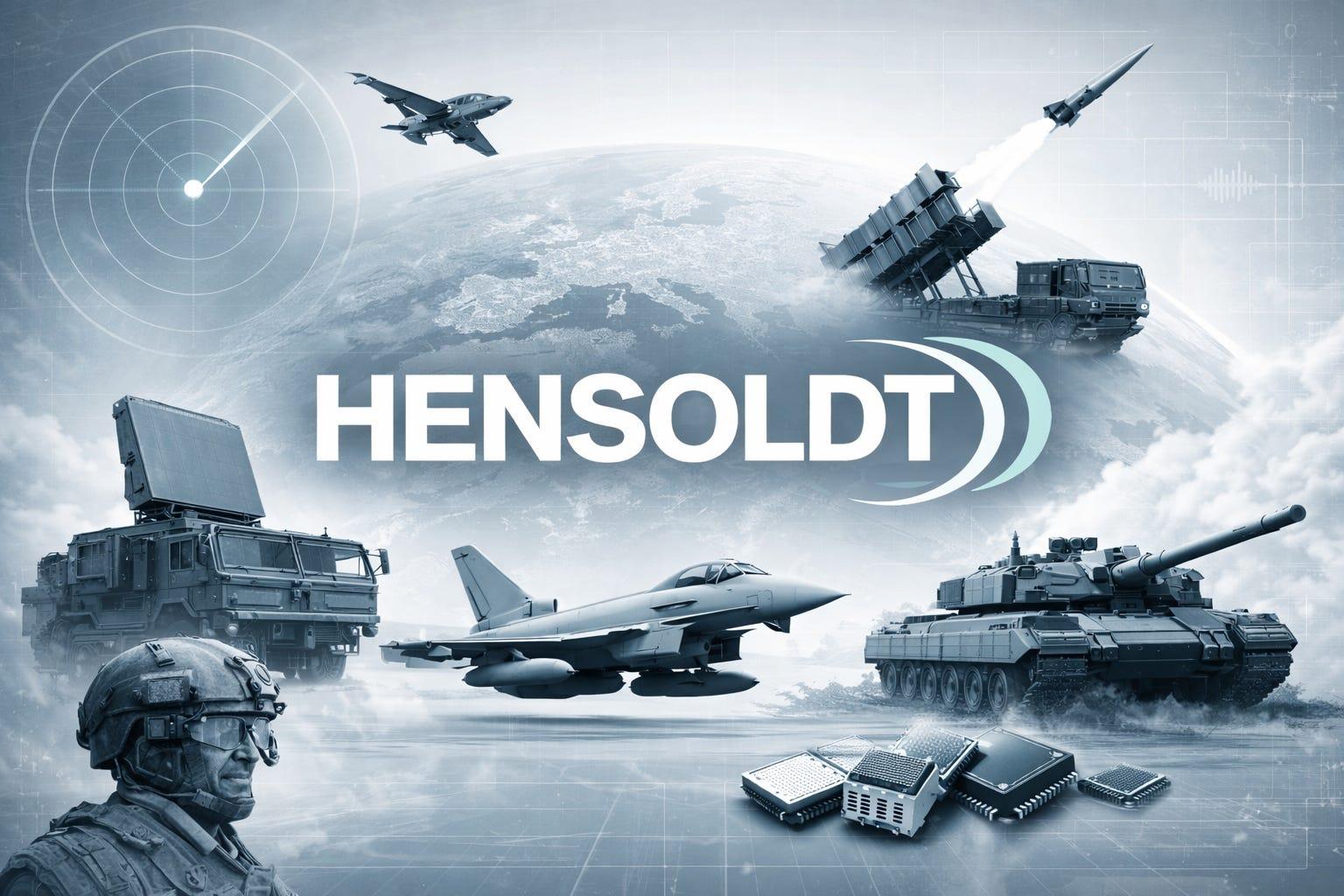
HENSOLDT is not a tank manufacturer. It is not a missile prime. It is the sensing, electronic warfare, optronics, mission-systems and integration layer that tells air defence where to look, helps aircraft survive, enables platforms to communicate, and increasingly turns hardware into software-defined defence.
That matters because in modern defence, the bottleneck is often not the visible end-product. It is the qualified subsystem that makes the whole stack work.
And right now, HENSOLDT looks a lot like one of those subsystems made public.
The core thesis in one line
HENSOLDT is a leveraged way to own Europe’s shift from ad hoc rearmament to repeatable, interoperable, sensor-heavy defence procurement.
That is why it fits the original bottleneck thesis so well.
The bull case is not just “defence budgets up.”
The bull case is that Europe is moving into a repeated game where underinvesting in radar coverage, electronic warfare, situational awareness, and systems integration becomes strategically irrational.
Once that happens, the supplier of those capabilities starts to look less like a contractor and more like a toll road.
What HENSOLDT actually is
The market still sometimes talks about HENSOLDT as if it were “just a radar company.” That undersells what the company has become.
According to its latest 2025 Annual Report, HENSOLDT finished fiscal 2025 with €4.71 billion of order intake, €8.833 billion of order backlog, €2.455 billion of revenue, €452 million of adjusted EBITDA, and €347 million of adjusted free cash flow. It also ended the year with 9,362 employees.
That is already a serious industrial platform.
But the more important point is how the company is organized.
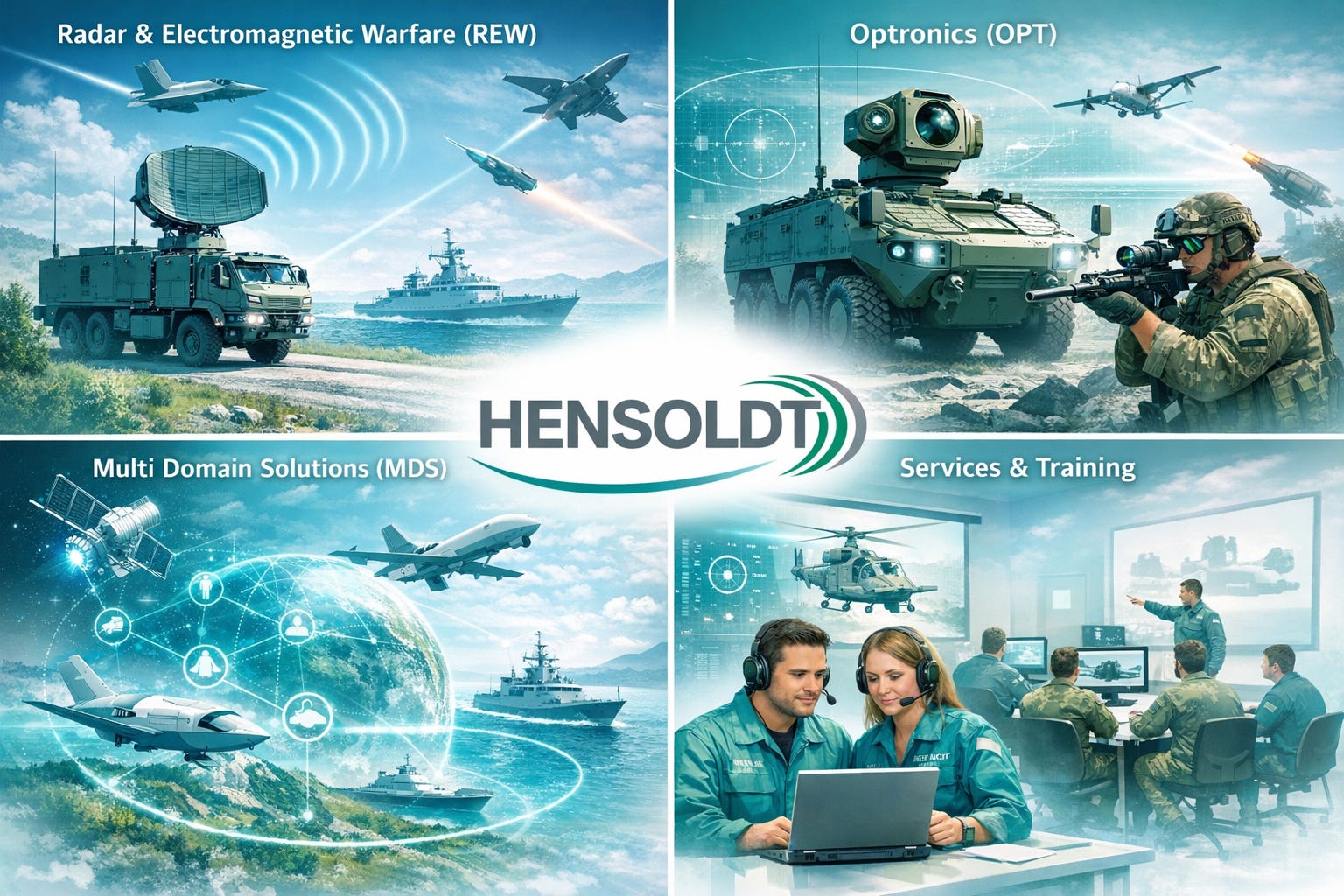
At the start of 2025, HENSOLDT implemented a new operating structure. The group still reports through two operating segments — Sensors and Optronics — but within Sensors it now organizes the business around four divisions:
Radar & Electromagnetic Warfare (REW)
Optronics (OPT)
Multi Domain Solutions (MDS)
Services & Training
The key change was the creation of Multi Domain Solutions, which bundles the former ESG division and the former Spectrum Dominance & Airborne Solutions activities into one integration-focused division.
That reorganization is not cosmetic. It tells you how management sees the market.
HENSOLDT is trying to move from being viewed as a component supplier toward being valued as a European defence electronics and systems-integration platform. Management’s language around software-defined defence and the launch of MDOcore, its software suite for multi-domain operations, makes that strategic direction explicit.
In plain English: HENSOLDT does not only want to sell sensors. It wants to sit in the layer that connects sensors, platforms, data and decision-making.
That is a far better place to be when defence procurement becomes network-centric.
Why HENSOLDT fits the bottleneck trade
In the original bottleneck article, the best setups were the companies exposed to spending that had become structurally less discretionary.
That is exactly the direction Europe is moving.
Official EU data show member states’ defence expenditure reached €343 billion in 2024 and is expected to reach €381 billion in 2025, while the EU’s Readiness 2030 / ReArm Europe plan is designed to mobilise up to €800 billion of defence spending support, including the €150 billion SAFE loan instrument for joint procurement.
That matters game-theoretically.
Once multiple states start coordinating on air and missile defence, drones, cyber, electronic warfare, and interoperability, the incentive structure changes.
No government wants to be the player that bought launchers without enough radar coverage.
No air force wants to modernise aircraft without modern self-protection, signal intelligence and mission systems.
No coalition wants new platforms that cannot talk to each other.
So the dominant strategy shifts toward continued investment in the enabling layer.
That is exactly where HENSOLDT sits.
The choke points are real, not theoretical
The strongest part of the HENSOLDT story is that the company is already embedded in the actual programmes Europe is prioritising.
Its TRML-4D radar is used in the IRIS-T SLM air-defence system. In 2025, HENSOLDT said it delivered additional TRML-4D and Spexer radars in a package worth more than €340 million to support Ukraine, while its annual report also points to demand linked to the European Sky Shield Initiative (ESSI).
This is the bottleneck logic in the real world.
Europe can talk about air defence all it wants, but air defence is not just missiles. It is radar coverage, target acquisition, tracking, identification, networking, sustainment and training. If those layers are constrained, the whole stack is constrained.
HENSOLDT’s own numbers show how aggressively it is responding to this. In the 2025 report, the company disclosed that TRML-4D capacity is now 8.5x 2021 levels, while Spexer capacity is 6.3x 2021 levels.
And crucially, management is not leaving the supply chain to chance. In March 2026, HENSOLDT signed a long-term GaN semiconductor supply agreement with UMS, covering 900,000 gallium nitride components through 2030 for radar systems.
That is exactly what bottleneck businesses do when they understand they are becoming bottlenecks: they lock in the upstream choke points before everyone else notices.
This is not just a radar story
The second reason HENSOLDT is interesting is that it is much more deeply embedded than the “radar company” label suggests.
The company is involved in the Eurofighter programme, where it is responsible for the ECRS Mk1 radar and the further development of the Praetorian self-protection system. It is consortium leader in PEGASUS, Germany’s airborne SIGINT platform. It also cited 2025 order momentum tied to P-8 Poseidon, and its Optronics segment benefited from major orders connected to Luchs 2 and Leopard 2.
This is important because it changes the economics.
When a defence supplier sits inside multi-year programmes across air defence, combat aircraft, reconnaissance platforms, SIGINT and land systems, the moat is not branding. The moat is qualification, installed position, programme intimacy, software integration, and the cost of replacement.
That is why switching costs in defence electronics are often much higher than investors coming from civilian industrials appreciate.
Once a supplier is certified, integrated and field-proven, replacing it is not like changing a seat vendor. It usually means delay, testing, recertification, integration risk and political friction.
That is bargaining power.
The structure of the business matters more than the headline multiple
The 2025 numbers tell a useful story about where growth is coming from.
In the Sensors segment, HENSOLDT generated €3.143 billion of order intake and €2.058 billion of revenue in 2025, with €394 million of adjusted EBITDA and a 19.2% margin.
In Optronics, the company posted €1.585 billion of order intake and €419 million of revenue, with €58 million of adjusted EBITDA and a 13.8% margin.
The most striking detail is the book-to-bill split.
Group-wide, HENSOLDT’s 2025 book-to-bill was 1.9x.
But in Optronics, book-to-bill was 3.8x, driven primarily by the late-2025 surge in orders tied to Luchs 2 and Leopard 2.
That is what a bottleneck order book looks like: not just healthy, but pulling future production forward.
Meanwhile, total backlog rose to €8.833 billion, which is about 3.6x trailing 2025 revenue.
That does not eliminate execution risk. But it does tell you the company is not relying on narrative alone. There is real contracted demand sitting behind the story.
Why the ownership structure is part of the thesis
A lot of investors treat ownership structure as a footnote.
Here it is part of the thesis.
As of 31 December 2025, the German state — through KfW — held 25.1% of HENSOLDT, while Leonardo held 22.8%.
That has obvious drawbacks if you want a pure “maximise quarterly EPS” setup.
But strategically, it also tells you what kind of asset this is.
HENSOLDT is not some floating supplier hoping to be noticed. It sits directly inside Europe’s defence-sovereignty architecture.
Germany has a strong incentive to preserve national and European competence in sensors, radar, EW and integration. Leonardo has strategic reasons to remain close as both shareholder and industrial counterpart. HENSOLDT itself notes that it collaborates with Leonardo across a series of programmes.
That combination matters.
It means the company is commercially listed, but politically and industrially anchored.
In a world where procurement is becoming more sovereign, more coordinated and more interoperability-focused, that is not a trivial advantage.
The real game-theory angle
The easiest way to misunderstand HENSOLDT is to think the thesis is simply “Europe spends more, HENSOLDT sells more.”
That is directionally true, but it misses the deeper point.
The stronger thesis is that HENSOLDT sits where the payoffs become asymmetric in a repeated game.
If Europe underinvests in munitions for one year, that can be corrected with future orders.
If Europe underinvests in sensor coverage, EW survivability, system integration and readiness infrastructure, it weakens the effectiveness of everything else bought around it.
That makes HENSOLDT’s category more strategically sticky.
In game-theory terms, it is easier for governments to postpone edge hardware than to leave the whole architecture less coherent and less interoperable.
And because the EU is increasingly pushing joint procurement and capability coalitions in areas like air and missile defence, drones, cyber and electronic warfare, the value of interoperable sensor and integration suppliers rises with every procurement cycle.
That is why HENSOLDT feels more like a system constraint than a simple procurement beneficiary.
What could go wrong
This is not a no-risk setup.
The main risk is not that demand disappears overnight. The main risk is execution.
HENSOLDT has to convert an enormous backlog into actual delivered systems. That means scaling production, ramping suppliers, hiring technical talent, integrating software and hardware across programmes, and keeping project timing under control.
The company’s own 2026 guidance reflects this reality. Management is guiding for around €2.75 billion of revenue, an 18.5% to 19.0% adjusted EBITDA margin, and a 1.5x to 2.0x book-to-bill ratio. But the order-intake guidance range is still wide — €4.125 billion to €5.5 billion — because the timing of large project awards remains inherently lumpy.
That is classic defence-industry reality.
Another risk is that the stock is no longer hidden. HENSOLDT has already rerated hard over the last three years. This is not a forgotten nano-cap buried in a supply chain.
So the question is not whether the market has noticed. It has.
The question is whether the market fully appreciates that HENSOLDT is migrating from “good radar house” toward “European systems-and-sensors toll road.”
That debate is still open.
Bottom line
In the bottleneck framework, HENSOLDT is not the cannon.
It is the eyes, the ears, parts of the nervous system, and increasingly part of the software layer that helps the rest of the force act like a system.
That is why it matters.
Europe can buy launchers, missiles, vehicles, drones and aircraft.
But without radar coverage, electronic warfare, platform protection, signal intelligence, networking and integration, those assets become less effective.
That is the choke point.
And HENSOLDT is increasingly built around owning it.
The company already has the backlog. It already has the programme exposure. It already has the sovereign relevance. It is already investing in capacity, locking down semiconductor supply, and pushing into software-defined defence.
So the cleanest way to frame the stock is probably this:
HENSOLDT is not just a beneficiary of Europe’s rearmament. It is one of the enabling layers Europe cannot comfortably scale without.
That is a much stronger place to be.
And in a market where structure matters more than story, that is exactly the kind of business worth studying.
Sources
Disclaimer: This is not financial advice. This article is for informational purposes only and reflects personal opinion, not a recommendation to buy, sell, or hold any security. Investing involves risk, past performance is not a guarantee of future results, and you should do your own research and consider consulting a qualified financial advisor before making any investment decisions.
More Articles
Turkey's 30% Trade: Everyone Wins — Until Someone Doesn't
A game-theory guide to the lira carry trade: who is really paying for the yield, how long the game can last, and what Ankara's central bank does next.

AI Is Creating an Inflation Nobody Is Measuring
The cost of producing music, code, and digital labor is collapsing. The volume is exploding. The market consequences are stranger than they look.

AI Won’t Kill SaaS. It Will Charge You Twice.
The old software model charged for employees. The new model charges for employees—and the AI agents doing part of their work.