
Most stock ideas start with a story. I think this crazy market is better understood as a game.
There are five important players right now: central banks, hyperscalers and chip customers, utilities and grid operators, governments, and the narrow suppliers that sit at the system bottlenecks. The key point is that several of these players are no longer acting in a normal discretionary way. Fed Governor Michael Barr said on March 24 that rates may need to stay steady “for some time” because inflation remains above target. At the same time, the U.S. Energy Information Administration expects electricity load to rise 1.9% in 2026 and 2.5% in 2027, with the highest pressure in regions like ERCOT and PJM, while the IEA says global data-center electricity use is on track to roughly double to around 945 TWh by 2030. Europe is running a similar strategic game in defense: the European Defence Agency estimates 2025 defense spending at €381 billion, and the European Commission’s Readiness 2030 plan aims to unlock more than €800 billion of defense spending, with SAFE as a €150 billion loan pillar.
That changes the payoff matrix. Hyperscalers cannot rationally underinvest in AI infrastructure if rivals keep spending. Governments in Europe cannot rationally underprepare in defense if peers rearm faster. Utilities cannot ignore load growth and reliability stress. In repeated-game terms, the dominant strategy is continued capex in a few specific lanes, even if the macro backdrop stays awkward. The bargaining power therefore shifts away from the glamorous end-product and toward the chokepoints: electrical gear, grid contractors, semiconductor inspection and metrology, defense electronics, and qualified missile/space components. That interpretation is reinforced by current supply-chain data: Broadcom said this week that TSMC capacity remains a bottleneck through 2026, while SIA and WSTS still point to a 2026 semiconductor market approaching $1 trillion.
That is the framework I used here. I also applied two hard screens. The stock had to still look like a genuine small- or mid-cap today, not six months ago, and it had to show clearly strong three-year performance. After re-checking the numbers, the five names I would keep are Powell Industries, MYR Group, Camtek, HENSOLDT, and Ducommun.
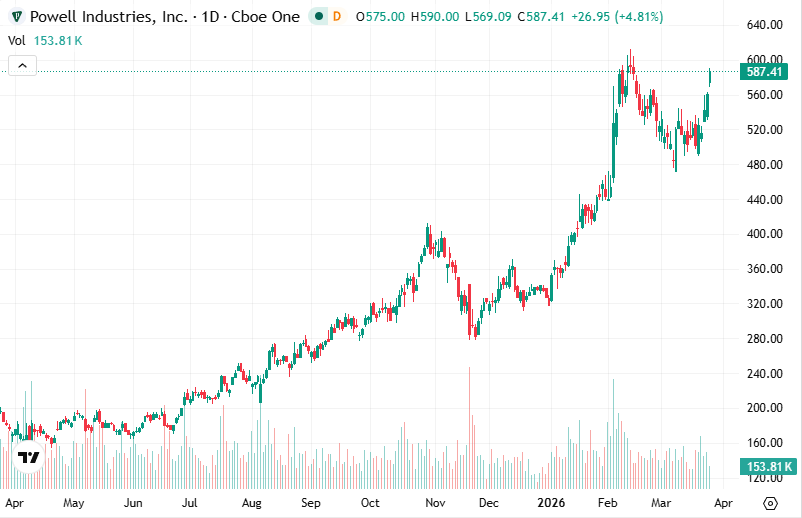
1) Powell Industries (NASDAQ: POWL)
Powell is still the cleanest power-infrastructure bottleneck name on the list.
It remains a true mid-cap at roughly $3.9 billion. Its three-year return is about +1,357%. Operationally, the latest quarter was strong: revenue rose 4% year over year to $251.2 million, gross profit rose 20%, net income rose 19%, new orders jumped 63% to $439 million, and backlog reached $1.6 billion. Cash and short-term investments were just over $500 million. Most importantly for the thesis, Powell said data-center orders in the quarter were well above $100 million and included its first data-center megaproject booking.
Game-theoretically, Powell benefits because customers do not want to be the player that loses time on energized capacity. When power delivery becomes the gating factor for AI, utility, LNG, and industrial projects, the supplier of critical switchgear and electrical systems gains leverage. That is exactly the sort of non-optional spend I want in this environment.
3) Camtek (NASDAQ: CAMT)
Camtek is my preferred small-/mid-cap semiconductor pick because it sits in inspection and metrology rather than in the most crowded compute narrative.
It still fits the size rule, with a market cap around $8.2 billion, and its three-year return is about +549%. The company’s 2025 report was excellent on the operating side: fourth-quarter revenue rose 9% to a record $128.1 million, full-year revenue rose 16% to a record $496.1 million, non-GAAP net income rose 15% to $159.0 million, and cash, deposits, securities, and equivalents reached $851.1 million. Management said it expects another double-digit growth year in 2026 and pointed directly to aggressive capacity expansion by customers. Camtek’s end markets include advanced interconnect packaging, heterogeneous integration, memory and HBM.
This is classic bottleneck logic. When chipmakers and advanced-packaging players are in an arms race, they can delay some things, but they cannot afford lower inspection quality or weaker yield control if competitors keep scaling HBM, chiplets, and advanced packaging. That makes process-control spending structurally stickier than many investors assume.
Positions from this analysis
+€442.93 total P/LMore Articles
AI Is Creating an Inflation Nobody Is Measuring
The cost of producing music, code, and digital labor is collapsing. The volume is exploding. The market consequences are stranger than they look.
AI Won’t Kill SaaS. It Will Charge You Twice.
The old software model charged for employees. The new model charges for employees—and the AI agents doing part of their work.
The AI Trade Is Not a Bubble. It Is a Game of Chicken.
The question is not whether AI is real. The question is who gets paid — and who is only financing the table.